NCD Alliance Statement on WHO Reports: Cheaper Drinks, Costly Consequences

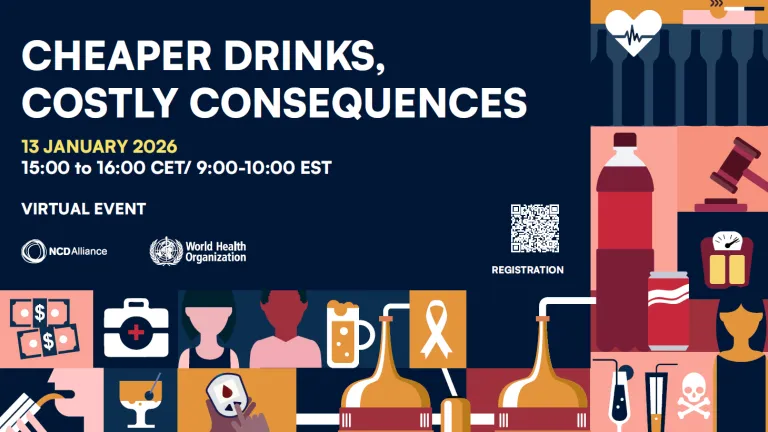
In a statement attributable to Alison Cox, Policy and Advocacy Director at NCD Alliance, NCDA responds to two new WHO reports on alcohol and sugar-sweetened beverage taxes, launched during a virtual event co-hosted by WHO and NCD Alliance. The statement highlights health taxes as a proven “triple win” for health, public finances and long-term costs.
The evidence is unequivocal: well-designed health taxes represent a clear “triple win”: better health outcomes, stronger public finances, and reduced long-term costs.
The pushback we saw around commitments to targets on health taxes in the negotiations of the 2025 UN Political Declaration reflects the continued influence of health-harming industries like producers of tobacco, alcohol and sugar-sweetened beverages.
Arguments around national sovereignty featured prominently, with some governments framing health taxes as external interference rather than legitimate domestic policy tools.
These sovereignty arguments can act as dog-whistle language obscuring the reality: health taxes can support national autonomy by increasing capacity to respond to domestic health and fiscal challenges on their own terms.
They protect population health while internalizing the social and economic costs of harmful products to the industries who create them – costs that would otherwise be externalized onto individuals, families, and overstretched public systems.
At the same time, they mobilise domestic resources, offering countries greater fiscal independence precisely when external funding is declining.
Yet evidence alone has not been enough to mobilise the political will required. Health taxes sit at the intersection of multiple sectors – finance, trade, agriculture, and industry – each with competing priorities.
Too often, health voices are isolated, while the responsibility of the whole of government to uphold the right to health is overlooked.
The dilution of ambition in the Political Declaration – from explicit target for tax increases to a vague target on “NCD measures” – illustrates this tension.
Ultimately, while global commitments matter, national action is where the real political economy battle over health taxes will be won. Leadership also matters. Initiatives such as WHO’s 3×35 campaign, launched at last year’s Financing for Development Conference, shows the renewed commitment from WHO, NCDA and other partners to advance policies that are both pro-health and pro-development – and countries should step forward and join this effort.
Having begun her career with environmental campaigning organisations including Greenpeace International, Alison went on to lead strategy development and direct advocacy for global public health alliances: for the Framework Convention Alliance, bringing the civil society to voice to the WHO treaty on tobacco control, and in the early years of the NCD Alliance (2011-12) leading on Rio+20 advocacy to ensure NCDs were recognised in what became the SDGs, and on developing our first strategy. As Prevention Director at Cancer Research UK (2013-21), she led successful national campaigns for restrictions on tobacco and junk food marketing, and built an international programme to support tobacco control advocacy in LMICs. In 2021, as Policy & Research Director for the Global Climate & Health Alliance, she coordinated the delivery to the global climate summit, COP26, of the Healthy Climate Prescription from organisations representing 46 million health professionals worldwide.