
COP11 reaffirms global commitment to stronger tobacco control amid rising industry interference

The Eleventh Session of the Conference of the Parties (COP11) to the WHO Framework Convention on Tobacco Control (WHO FCTC) took place last month in Geneva, bringing together governments and civil society with the majority sharing a key goal: to accelerate the implementation of the WHO FCTC and protect future generations from the avoidable harms of tobacco use. NCD Alliance participated for the first time after being granted observer status at COP10. Despite increasingly complex geopolitical dynamics and rising tobacco industry interference, Parties succeeded in advancing several decisions.
Across the week of negotiations, Parties reiterated the importance of the WHO FCTC for health promotion and NCD prevention. Delegates raised numerous challenges including political will, novel products, limited resources and capacity, and growing industry interference. Nevertheless, key decisions were adopted, including on Article 2.1 on Forward-Looking Measures which invites Parties to consider additional measures beyond those required; Article 18 on the Environment to support Parties in preventing and managing the environmental harm caused by tobacco; and Article 19 on Liability, which invites Parties to consider legal, administrative and other non-judicial actions against the industry where relevant.
Proposed by Senegal, Parties also adopted a decision on the mobilisation of sustainable resources to support implementation of tobacco control efforts, highlighting the role of tobacco taxes and catalytic development assistance. Ensuring adequate and sustainable funding is essential in the current times of growing fiscal constraints and shrinking ODA as highlighted by the statement led by NCD Alliance. The upcoming WHO Dialogue on Sustainable Financing for NCDs and Mental Health, hosted by the Philippines in 2026, will be a critical moment to mobilise resources and integrate tobacco control into broader NCD and health financing strategies.
Notably, not all draft decisions were able to be adopted, including on nicotine addiction, which after failure to reach consensus saw the issue postponed to COP12, scheduled to take place in Yerevan, Armenia in 2027.
Despite these important advances, tobacco control efforts continue to face fierce pushback from the industry. Earlier in the year, we witnessed during negotiations for the Political Declaration of the fourth UN High-Level Meeting on NCDs and Mental Health the weakening of key commitments including the removal of references to graphic health warnings and plain packaging and the dilution of comprehensive bans on tobacco advertising to mere restrictions. Similar patterns were visible at COP11, where several draft decisions were significantly weakened during negotiations, reflecting a clear and coordinated push by certain actors leveraging industry-driven narratives and undermining evidence-based measures.
Civil society, led by the Global Alliance for Tobacco Control (GATC), played a key role throughout the week. GATC’s daily analysis, advocacy and the widely followed daily bulletins, provided indispensable support to Parties while countering industry interference. Without these coordinated efforts, many of the advancements witnessed at COP11 may not have been possible. In its press statement, GATC highlights the progress made at COP11, but also the pressing need for further action.
At the same time, COP11 provided a platform for several inspiring side events on various topics including on gender, industry interference and narratives, youth advocacy, environmental impacts, taxation, and indigenous leadership, highlighting the far-reaching harms of tobacco, the many challenges of tobacco control but also crucially, the opportunities and success stories.
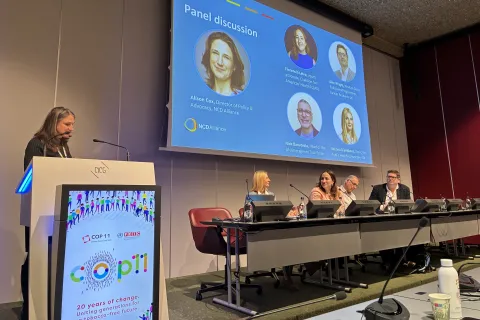
The NCD Alliance, together with the Ministry of Health of Ghana and several NGO observers, hosted a well-attended COP11 side event “Strengthening Tobacco Control to Achieve SDG 3.4 on NCDs: A Global Imperative”. Featuring government speakers from Ghana and Mexico, and also from civil society and the United Nations Inter-Agency Task Force (UNIATF) on NCD Prevention and Control, the session underscored the inextricable link between tobacco control and NCD action and provided reflections on the commitments within the Political Declaration on NCDs – including the target of 150 million fewer people using tobacco by 2030. Speakers highlighted national experiences of tackling tobacco, and the importance of a whole-of-government approach, resourcing action, and protecting policymaking from vested and commercial interests.
Without decisive action in these areas, the global target to reduce premature NCD deaths by one-third by 2030 (SDG 3.4) will remain out of reach. While there has been substantial progress advancing tobacco control – including tobacco use among adults decreasing from 33% in 2000 to 19.5% in 2024, progress remains uneven and only 61 countries are on course to achieve the target of a 30% reduction in tobacco use prevalence by 2025.
Renewed momentum from the decisions adopted at COP11 and the NCD Political Declaration, adopted this week by the UN General Assembly, represents an important opportunity to advance meaningful action.
See NCD Alliance's statement on the Global progress in implementation of the WHO FCTC below: