
NCDs discussed amid global health reform process and deep geopolitical divides
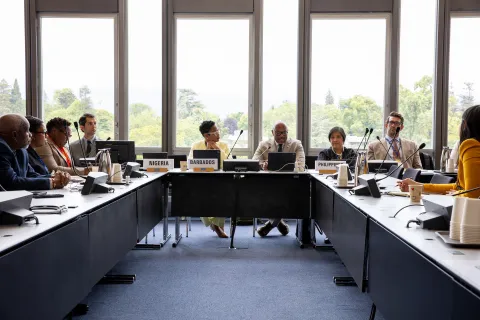
The 79th session of the World Health Assembly (WHA79) was marked by deep geopolitical divisions, reflected in a high number of votes during the week, from procedural disputes over the agenda to contested resolutions on health in conflict settings.
The session also unfolded against the backdrop of the Ebola and Hantavirus outbreaks, and negotiations on the Pathogen Access and Benefit-Sharing (PABS) annex to the World Health Organization (WHO) Pandemic Agreement, though ultimately deferred, added urgency to the week's central question: the future of Global Health Architecture.
Member States agreed on a joint process for global health architecture reform, hosted by WHO and “Member State-led", a signal that despite the tensions, there is still commitment to the multilateral system for global health.
UN HLM on NCDs and mental health: Time to deliver on commitments
WHA79 was the first Assembly session since the adoption of the United Nations (UN) Political Declaration on Non-Communicable Diseases and Mental Health, described by Dr Tedros as “the most ambitious political declaration yet”.
Member States reflected on its implementation, and the room broadly welcomed the new targets, as well as the inclusion of mental health within them. Botswana and other Member States called to convert these political commitments into action to accelerate progress towards the Political Declaration's global targets by 2030. As stated by Belgium, “The commitments made under this declaration are essential, and we have now given WHO the task of monitoring its ongoing implementation".
- Commercial determinants of health: Papua New Guinea, speaking on behalf of Pacific Island States, delivered a stark intervention, describing NCDs as not just a public health issue but "a development crisis" in a region where "the aggressive marketing of tobacco, alcohol, and ultra-processed foods has worsened the [NCD] epidemic”. Estonia and Spain called for health taxes, marketing restrictions on unhealthy products, and policies free from commercial interference.
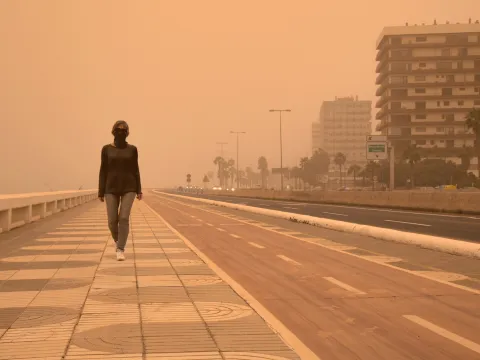
- Planetary health: Conversations on the sidelines of WHA were also crucial. NCD Alliance (NCDA) launched its new report – A Breatheable Planet: Best Practices for Clean Air Policies to Meet NCD Targets – at a side event to ensure that addressing environmental determinants of health remains part of the implementation picture. And the new call for the UN NCD Task Force Award 2026 was announced during WHA79, with a focus this year on work to prevent and manage chronic respiratory diseases while reducing the harmful impact of air pollution on human health.
- Health systems: The need for equitable access to essential medicines and integrated care through primary health care (PHC) was also a recurring topic of discussion, with several low- and middle-income countries, notably Egypt on behalf of the EMRO, citing financing gaps, health workforce shortages, supply constraints and lack of access to medicines as the real barriers to implementation.
- Financing: Resourcing the NCD response remains a major critical gap between political commitment and action, as captured in our constituency statement. On a related note, NCDA co-hosted an official event on the sidelines of WHA79 on aligning sustained financing for NCDs and Mental Health (see recording here). Further discussions are expected ahead of the 3rd WHO International Dialogue on Sustainable Financing for NCDs and Mental Health, taking place in Manila from 2–4 September 2026, as announced during the Assembly by the Philippines.
Finally, WHA79 saw the adoption of two new resolutions under the NCDs agenda item, on steatotic liver disease and on haemophilia and blood disorders, calling for their integration into NCD plans and broader health strategies.
A long-awaited resolution on stroke was also adopted under the Universal Health Coverage item (see WSO constituency statement). The NCD community welcomes this cross-cutting approach, reflecting the burden these conditions represent.

Reimagining the global health landscape
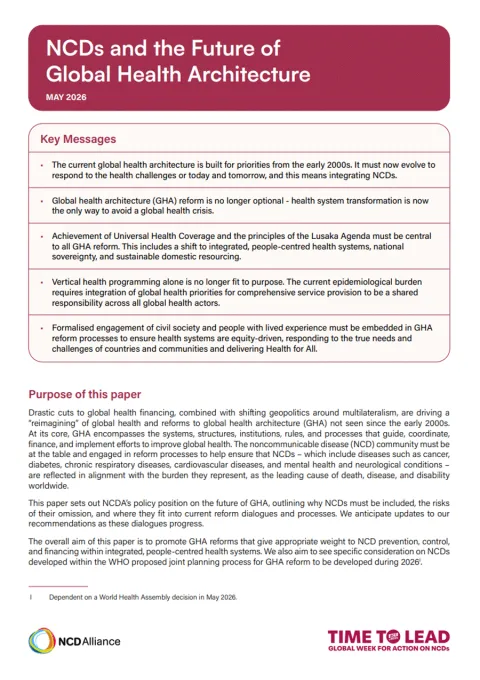
The global health landscape is undergoing rapid change. Drastic cuts to global health financing, shifting geopolitics and renewed debates on multilateralism are driving a 'reimagining' of the global health architecture not seen since the early 2000s.
President Mahama of Ghana reminded the assembly:
"We are witnessing the end of an era, and we must have the courage to build the next one. An order defined by agency, not aid, and by partnership, not paternalism. (...) If we launch a reform process that is ineffective, it is just a ritual. We must not protect silos but fearlessly analyse what works.”
WHO presented a formal proposal at WHA79, as requested by the Executive Board last February. The proposed joint process is organised around three function-based objectives (mandates, coordination, and financing), to be taken forward by a joint task force supported by a dedicated secretariat. A four-phase roadmap will involve mapping, stakeholder consultations, and board reviews, culminating in a consolidated set of recommendations for consideration at WHA80.
Broad support for the joint process was evident and taken forward unanimously, but sharper divisions emerged around governance and financing risks. Many countries, including Mexico, Nepal, and Pakistan, warned that the process should not serve as political cover for reducing official development assistance (ODA).
Lebanon's intervention was a welcome reminder that resilient and equitable health systems must be built to address the growing burden of NCDs. We should ensure that NCDs and mental health interests are represented within the governance structures and outcomes of the reform process to balance their omission from existing global health initiatives.
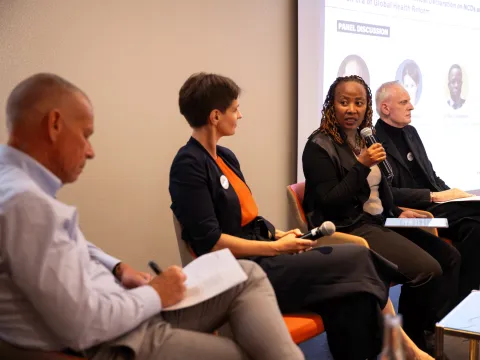
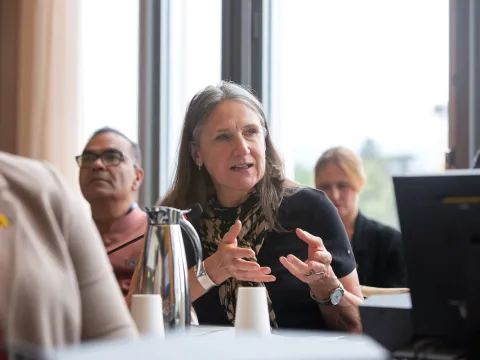
“Global health reform will fall short unless it reflects today's health realities”, leaders warned at NCDA's flagship event on the sidelines of WHA79. The event brought together a wide range of stakeholders to explore how the 2025 Political Declaration can be implemented in a rapidly changing global health landscape. Highlights included calls for faster progress on integration and stronger community engagement in the reform process, before the panel turned to how global health architecture can better reflect today's epidemiological reality.
The week before, in her opening remarks at “The Pulse of Tomorrow: Shifting the Paradigm for NCDs in Global Health Architecture” webinar, co-organised with the Karolinska Institutet, NCD Alliance CEO, Katie Dain, underscored the critical role of civil society in shaping global health reforms.
Inclusivity was another core principle mentioned. Several Member States, including Belgium, the UK, Thailand, Germany, Lebanon, Norway and Spain, called for stronger civil society organisation engagement “as they play a vital role in working with and representing communities”.
Civil society also raised serious concerns about being shut out of the joint task force: In a constituency statement, NCDA, with other CSOs, highlighted that the absence of civil society and impacted communities from the body that will steer this process removes a critical force for accountability, equity, and real-world impact, principles that many Member States themselves called for during the discussions.
These concerns were also raised in by constituency statements led by Save the Children and Women in Development. Wellcome Trust, who published that week the report from their Global Dialogue on “Rethinking the future of global health”, also raised this concern in their individual statement.
When economic and health policies reinforce one another
On Saturday morning, the Assembly approved with broad support a decision to adopt WHO's Strategy on the Economics of Health for All (2026-2030), a significant step towards positioning health as a foundational investment for economic growth and social development.
The debate reflected a broad consensus and Brazil captured it: health must be recognised as "a cornerstone of national prosperity, not a fiscal burden”. The Philippines echoed this, noting that in a period of fiscal uncertainty, economic and health policies must reinforce one another, and that health is an investment for inclusive and sustainable development.
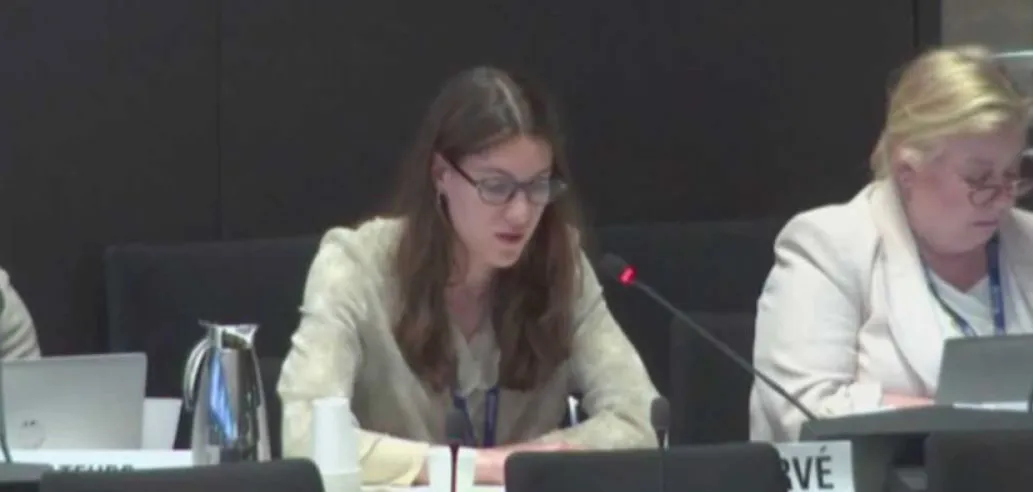
But one critical gap remains, as we stressed out in our constituency statements: the urgent need to distinguish between public economic interests and private commercial ones. While the final strategy still recommends actions to address harmful commercial practices, it no longer explicitly acknowledges the commercial determinants of health. This omission signals a reluctance to confront a fundamental barrier to implementing robust 'economics-of-health-for-all' models. Such models must ensure that the social and economic costs associated with health harming products and commercial practices are not externalised onto individuals and public systems.
UN High-Level Meeting on Universal Health Coverage (UHC) on the horizon
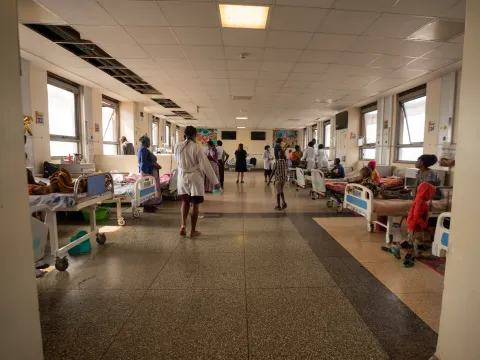
Throughout WHA, debates were shaped in what Norway described as "the downward slope of global progress towards UHC". Member States pointed to persistent gaps in UHC, particularly out-of-pocket spending and continued inequalities in service coverage.
Several delegations also highlighted what is holding back progress. Micronesia, Ghana and Namibia identified underfunding and underinvestment in PHC as a core barrier. Botswana put it plainly: "Investment in PHC is the most effective pathway toward UHC ahead of the 2027 UN High-Level Meeting." Health workforce shortages and stockouts of essential medicines were repeatedly raised as ongoing obstacles.
NCD integration was positioned as central to the UHC agenda. Saudi Arabia described NCDs and mental health are two major pillars for achieving UHC. Qatar and Guatemala stressed the pressure that NCDs and widening inequalities are placing on health systems, while other interventions pointed to stronger local capacity and PHC as part of the response. Indonesia argued that addressing NCDs and mental health requires integrated, people-centred, and life-course approaches supported by strong PHC. A welcome signal came from Kenya, which reported that essential NCD services are now available in over 90% of their PHC facilities.
Conclusion
WHA79 closed a few days ago, not without challenges. Dr Tedros perhaps said it best in his closing address:
"This Assembly has shown that progress is still possible, even when the wider context is difficult. That is exactly the point of multilateralism: not to pretend the difficulties of our world are not there, but to address them together."
Yet, still much lies ahead. The 2027 UN High-Level Meeting on UHC, the election of the next WHO Director-General, and the ongoing reforms of WHO and of global health architecture will all shape the landscape in which the NCD community works.
If governments fail to seize the opportunity presented by global health architecture reform to build a more equitable, integrated, and people-centred system, they will be failing billions of people living with or at risk of NCDs. The world can no longer afford a fragmented and inadequate response to NCDs.
Mina Pécot-Demiaux joined the NCD Alliance Policy and Advocacy team in January 2025 as the Policy and Advocacy Officer to support the work of the global policy team, with a particular focus on Care, from Primary Health Care and UHC to the integration of NCDs into other global health priorities. After gaining early experience in Geneva, where she contributed to projects supporting access to healthcare for the most vulnerable communities in Kabul, she began her career in Brussels within non-governmental organisations and European institutions, focusing on issues related to development, global health, and climate financing