Rethinking Africa’s Future: Why Political Commitment is Critical to Reinforce Health in All Policy for Reducing Premature Deaths
While infectious diseases often dominate global headlines, a silent epidemic is quietly fracturing Africa’s social and economic fabric. Noncommunicable diseases (NCDs), injuries, and mental health conditions (NCDIMH) have emerged as primary, compounding threats to the continent’s development.
The statistics are a stark wake-up call:
- The burden of NCDs: NCDs alone account for a staggering 74% of Africa’s overall disease burden and are responsible for more than one-third of all deaths on the continent.
- The toll of injuries: The African region suffers the world’s highest road traffic mortality rate (26.6 per 100,000 population), while drowning remains a leading, tragic cause of child mortality.
- The mental health crisis: an estimated 14% of Africans live with a mental health condition, predominantly enduring the heavy, unaddressed burdens of depression and anxiety.
This is not merely a medical crisis; it is a profound economic development threat. When a breadwinner falls ill, catastrophic out-of-pocket health expenditure plunges entire families into poverty. The World Health Organization (WHO) projects that if NCDIMH interventions are not aggressively prioritised, these conditions will drain over US$500 billion from African economies by 2030.
To safeguard communities and meet both continental targets and United Nations Sustainable Development Goal (SDG) 3.4, Africa CDC, in collaboration with the African Union Multisectoral Taskforce on NCDIMH, is spearheading a decisive shift toward Health in All Policies for integrated, multisectoral prevention and control measures.
What Africa CDC multisectoral strategies are about
Reversing the NCDIMH trajectory requires Africa to embrace Health in All Policies and principles and operationalise a whole-of-government and whole-of-society approach. Because NCDIMH conditions are driven by a complex web of commercial, environmental, and behavioural risk factors, traditional healthcare silos are structurally insufficient to resolve an epidemic rooted in trade, infrastructure, education, and urban design.
To operationalise health-in-all policies, Africa CDC has institutionalised four cornerstone multisectoral strategies:
- Established an African Union Multisectoral Taskforce on NCDIMH: The Taskforce oversees the design and execution of enabling legislation and policies to strengthen Member States’ inclusive multisectoral action.
- Adopted a high-level policy advocacy instrument: In September 2025, AU Member States validated the African Union Common Position on Multisectoral Engagement, Coordination and Action (MECA). This was endorsed at the 39th AU Ordinary Session of the Heads of State and Government in February 2026, a landmark milestone that locks in the highest-level government accountability and elevates non-communicable health conditions to the priority health security and sovereignty agenda.
- Developed a continental framework on MECA: The MECA framework guides strategic interventions and measurement indicators for the multisectoral model. It will help African Union Member States develop context-relevant national multisectoral action plans that bridge health and non-health sectors.
- Provides technical assistance for country-led action: Africa CDC provides targeted technical support to help Member States create country-led Multisectoral Action Plans (MAPs). To drive transparency and accountability for results, these plans will be tethered directly to continental performance monitoring scorecards that will become interoperable with national data management systems and digital visuals.
The adoption of the Common Position on MECA by African Heads of State in February 2026 represents a landmark political achievement, one that signals Africa now recognises NCDIMH not simply as a health issue, but as a development, economic, and social priority. It provides a legal and diplomatic mandate for governments to move beyond declarations of intent and towards enforceable, structural action that reduces premature mortality.
High-level political declarations do not, by themselves, save lives. The real test of commitment begins after endorsement, when countries translate continental commitments into national legislation, policies, budgets, implementation plans, and measurable improvements in people’s lives.
Risk prevention and control demand genuine co-ownership by sectors traditionally delinked from the health sector: finance, agriculture, transport, trade and industry, and urban planning, and joint efforts to mobilise more domestic and external funding. To this end, the African Union Multisectoral Taskforce plays a pivotal role in mobilising various AU organs and specialised agencies working hand-in-hand with different sectors in AU Member States.
Role of civil society and individuals with lived experience
Civil society and individuals with lived experience are critical to ensuring that policy formulations and programme design processes bear fruits. For the Common Position to achieve its intended impact, governments should not treat civil society merely as an advocacy or awareness-raising constituency, but as a strategic governance partner — one that contributes to agenda-setting, accountability, community mobilisation, and continuous learning.
People living with NCDIMH conditions face not only disease burdens but also catastrophic costs, stigma, and inequitable access to care. Across Africa, civil society organisations (CSOs) are often the first responders to these realities. They bring lived experience, community trust, and independent accountability — raising awareness, advocating, holding institutions to account, and promoting access to health services for people living with diabetes, hypertension, cancer, chronic respiratory disease, sickle cell disease, and mental health conditions.
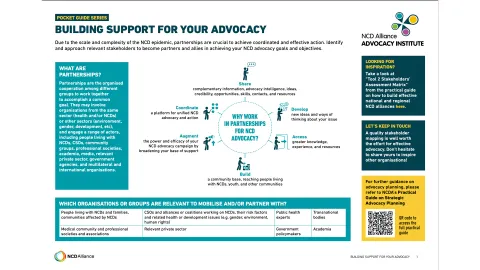
Since 2015, the African NCDs Network (ANN) has advanced the NCD prevention and control agenda across the continent through five pillars: capacity development and research; policy engagement; affordable access; financing; and people power — ensuring the meaningful involvement of people living with NCDs and other vulnerable groups in decision-making.
ANN amplifies civil society’s voice in continental processes, including advisory and technical working groups, and has represented the NCD civil society voice in WHO regional committee meetings for three consecutive years, alongside advocacy campaigns aligned with the NCD Alliance Global Week for Action. As a regional platform bringing together national NCD alliances from across Africa, the ANN works to transform individual country efforts into a coordinated continental movement, connecting national alliances, facilitating peer learning, strengthening advocacy capacity, and promoting unified regional positions.
Keeping people living with NCDs at the centre of implementation is equally important. The ANN trains at least 20 people with lived experience every year to strengthen their meaningful engagement, because national policies are most effective when informed by those who understand, first-hand, the barriers to diagnosis, treatment, continuity of care, and financial protection.
Regional coalition-building has become increasingly important as health challenges such as unhealthy food environments, tobacco and alcohol control, access to essential medicines, and sustainable financing for NCDs transcend national borders; strong regional networks accelerate the sharing of evidence and successful policy innovation. The Common Position therefore offers an opportunity not only to strengthen multisectoral governance, but also to institutionalise the meaningful engagement of civil society and people living with NCDs within national coordination mechanisms — extending their participation beyond consultation to active involvement in planning, implementation, monitoring, and evaluation.
A call for concerted sustained action
The endorsement of the Common Position by the AU Assembly must not sit on a shelf as a statement of intent; it must act as a catalyst for measurable improvement in health and development across Africa. Curbing this epidemic is a defining economic imperative for the continent’s sustainable development and collective prosperity, and success will require sustained political leadership, domestic investment, multisectoral collaboration, and robust accountability. We call for immediate, decisive action across the following:
- Heads of government and state: Establish and empower a permanent, supra-ministerial or inter-ministerial governing body, directly under the office of the President or Prime Minister, to mandate, align, and fund national efforts in NCDIMH prevention and control.
- Supra-ministerial bodies and line ministries (finance, transport, agriculture, education, and trade): break the silos. Jointly plan, budget, implement, and enforce cross-sectoral health legislation, such as tobacco and alcohol taxation, mandatory food labelling, road safety enforcement, and urban green-space zoning.
- Ministers of Health: Institutionalise formal, permanent platforms that guarantee civil society organisations and people with lived experience a seat at the table in policy formulation, strategy design, and implementation review.
- African Union organs and specialised agencies: Collaboratively implement and track performance using the Continental Scorecard to monitor national progress, hold lagging systems to account, and scale up documented best practice.
- Clinicians, researchers, and academics: Prioritise the NCDIMH agenda across all levels of health delivery and research, translating local data into actionable policy briefs that drive political action.
- International partners and donors: Align external financing with country-led MAPs, moving away from disease-specific silos towards integrated, systemic health financing.
- Civil society and people with lived experience: Provide permanent seats in national and continental governance bodies, with dedicated resources; support joint accountability mechanisms, including civil society shadow reporting on the Continental Scorecard; direct domestic financing for community-based, integrated NCDIMH services; and strengthen the capacity of national alliances to generate local evidence and policy briefs in support of Member States’ actions towards 2030.
This is a historic opportunity to secure a healthier, more prosperous and self-reliant Africa. The frameworks are signed and the mandate is clear; working together, Africa CDC, Member States, the African Union, civil society, and development partners are ready to mobilise communities, strengthen accountability, generate evidence, and ensure that implementation remains focused on the people these commitments are intended to serve. The time to act is now.
Dr Mohammed Abdulaziz holds a master’s degree in Public Health and is a specialist in psychiatry with over 27 years of clinical and public health experience in Nigeria and across Africa. He is Head of Division for NCDs, Injuries and Mental Health at the Africa Centre for Disease Control and Prevention, headquartered in Addis Ababa, Ethiopia. He is a Fellow of the West African College of Physicians and originator of the Africa CDC multisectoral strategies and the MECA flagship programme. Email: mohammedab@africacdc.org.
Dr Manuel Kassaye Sibhatu is a senior public health leader with a Master’s degree in Public Health, a specialist in internal medicine, and an expert in healthcare quality and safety management. He currently supports Africa CDC’s flagship multisectoral policy framework and co-creates multisectoral action plans and MECA measurement scorecards. Email: ManuelK@africacdc.org.
Dr Kaushik Ramaiya is a senior Internal Medicine Consultant & Endocrinologist based at Shree Hindu Mandal Hospital, Dar es Salaam, and Honorary Professor of Medicine & Global Health at LSTM and UCL. He is President of the East African NCD Alliance and Africa NCD Network and member of the Board of World Diabetes Foundation.
Mr Mbiydzenyuy is the Executive Director of the Africa NCDs Network and Secretary General of the Cameroon Civil Society NCD Alliance. He has been building coalitions in Cameroon and across Africa since 2013 and leads civil society initiatives that advance evidence-informed policy, accountability, and multisectoral action to prevent and control noncommunicable diseases. He holds a master's degree in Public Health Economics, policy and management. Email: ferdinantmbiy@recdev.org .