Our Promise to the Future: Why Kidney Care is the Litmus Test for More Sustainable NCD Leadership
We are in a transformative period for global health policy. The Political Declaration of the Fourth UN High-Level Meeting on NCDs and Mental Health (HLM4), which was adopted in December 2025, represents a significant milestone for the global kidney community. The declaration is the first of its kind to explicitly cite kidney health three times, effectively integrating it into the global NCD and mental health agenda.
But a declaration is only as strong as its implementation. Accountability is required to see its impact on patients’ lives.
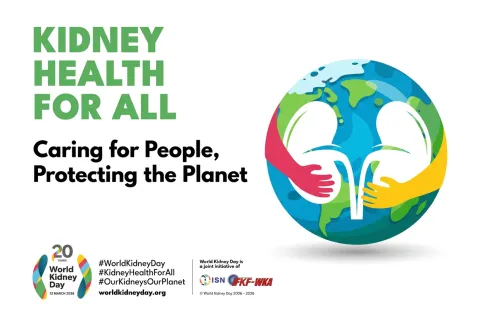
For the global kidney community, the theme of this year’s World Kidney Day, Kidney health for all: Caring for people, protecting the planet, is more than a clinical goal; it is a moral imperative. It represents a shift from surviving to thriving in a way that protects both our health and our planet.
Elevating Kidney Health as a Global Priority
Significantly, this year is the first time that World Kidney Day is being officially recognised by the World Health Organization (WHO). This landmark decision, approved in the WHO Kidney Health Resolution at the 2025 World Health Assembly, elevates kidney health as a global public health priority. This historic observance urges the world to act on prevention, awareness, access to treatment, and the reduction of environmental risks.
During the World Economic Forum (WEF), WHO Director-General Dr. Tedros Ghebreyesus emphasised that solving “intractable” NCD challenges requires robust “multilateral architecture.” This call is powerfully echoed in WEF’s concurrent report, Acting Early on Non-Communicable Diseases, which provides a framework for health systems to move away from siloed, disease-specific approaches. It calls for greater coordination and integrated care across conditions that share risk factors and biological pathways. We believe that kidney disease is at the centre of this interconnection of metabolic conditions, acting as both a driver and a consequence of other major NCDs like diabetes and cardiovascular disease. Effective NCD policy for one disease must therefore consider how it impacts and is impacted by others: all for one and one for all.
The WHO Resolution: From Early Detection to Affordable Care
The WHO Kidney Health Resolution provides the roadmap we need, but its success depends on implementing two critical pillars: Early Detection and Prevention and Affordable Access to Kidney Replacement Therapy (KRT).
- Early Detection and Prevention: As indicated by the WEF report, health systems must shift from reactive, late-stage treatment toward prevention and early intervention. Detecting kidney disease early through integrated primary care settings can slow progression and reduce reliance on resource-intensive therapies.
- Affordable Access to KRT: Sustainable care must include equitable and affordable access to KRT. We cannot ignore those who currently need life-saving treatment. In many countries, the high cost of dialysis creates severe financial hardship. We need innovative solutions to ensure every patient has access to the highest quality of care.
Caring for People, Protecting the Planet
This World Kidney Day’s theme, Kidney health for all: Caring for people, protecting the planet, is critical for patients and the planet. However, there is an underlying paradox. Climate change and environmental toxins are direct threats to kidney and human health, yet many life-saving treatments have a significant environmental footprint. Leadership in 2026 means breaking this cycle by addressing both traditional and non-traditional risk factors.
- As providers, we are fostering sustainable solutions in nephrology, by advancing greener nephrology practices aimed at reducing clinical waste.
- As industry partners, research and development efforts increasingly focus on sustainability, including more environmentally friendly products and home-based therapies.
- And as patients, we are ensuring that policy ambition translates into meaningful improvements in prevention, access, and quality of care.
The “leadership gap” in the NCD response is not a gap in intent but accountability. We urge national leaders to deliver on their HLM4 promises by investing in more sustainable responses that integrate kidney health into the broader climate and health agenda.
More sustainable kidney care is a clinical and economic necessity. This World Kidney Day, we are not just raising awareness; we are demanding political will to ensure that “kidney health for all” means a healthier population and a healthier planet.
The roadmap is clear. The resolution is approved. The UN Political Declaration on NCDs and mental health is adopted. Now is the time to act.
Ifeoma I. Ulasi FWACP; FRCP (Lond.), FNAN, FISN: is a professor of medicine at the College of Medicine, University of Nigeria and has affiliations with two Teaching Hospitals UNTH. She is an international adviser at the Royal College of Physicians, London. She is the Chair of the ISN Advocacy Working Group. She is also a member of the African Regional Board, iNet and ACTS Committees. She served in the ISN-ExCom 2021-2023. She is involved in various research initiatives and projects on kidney and non-communicable diseases. She is a site PI of the H3Africa Kidney Disease Research Network and PI of the Health Heredity and Environment Research Initiative. Also, the National Coordinating PI for Vertex Amplitude Study in Nigeria. She is an associate editor of the American Journal of Kidney Disease, Transplant International Journals, and the Journal of the American Society of Nephrology.
Peter Rutherford, M.D., Ph.D., is Global Head of Worldwide Medical at Vantive. As such, he leads the company’s medical team and is responsible for clinical research, scientific engagement, medical communications and global patient safety. Previously, Rutherford held positions of increasing responsibility at Baxter International from 2007-2015, then returning to the company in 2021 as the vice president of kidney care global medical affairs. Upon his return, he played a key role in the company’s collaborative efforts with clinicians and healthcare professional and patient organizations to support kidney patients' unique needs.