Financing must match NCD and mental health commitments

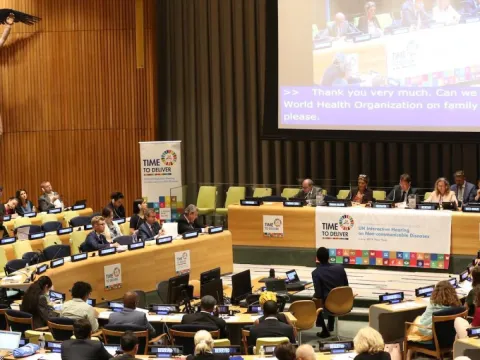
Governments and partners must mobilise adequate and sustained financing for noncommunicable diseases (NCDs) and mental health if commitments made at the 2025 UN High-Level Meeting are to become reality, leaders said at an official side event during the 79th World Health Assembly.
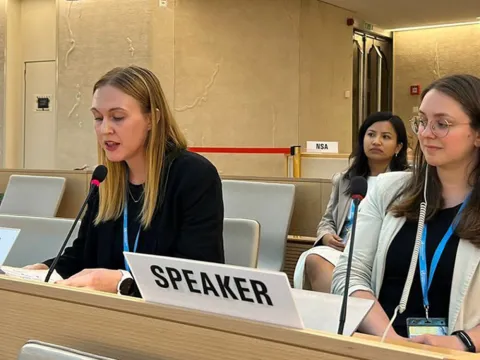
The event, Adequate and sustained financing for NCDs and Mental Health: Approaches to closing the implementation gap, was organised by the Government of Barbados, NCD Alliance and United for Global Mental Health, with the Governments of Brazil and the Philippines, UNDP, the UN Inter-Agency Task Force on NCDs and the Healthy Caribbean Coalition.
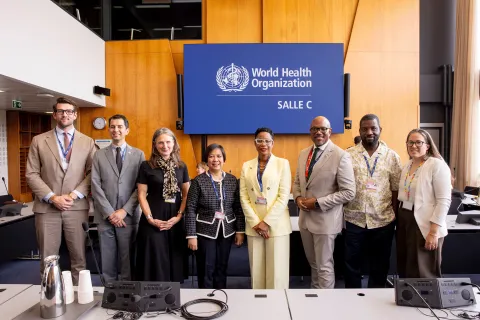
Held at WHO headquarters in Geneva, the event explored practical financing solutions to support implementation of the 2025 Political Declaration, including health taxes, strategic use of development assistance, debt-for-health swaps, and South-South collaboration.
Financing is the missing link in implementation
Speakers warned that insufficient financing for NCD prevention and care, and for mental health promotion, continues to limit country progress despite renewed political commitments.
While domestic financing must be the backbone of national NCD and mental health responses, speakers also discussed the role of catalytic development assistance, including pooled funding mechanisms such as the UN Health4Life Fund.
Senator The Honourable Lisa Cummins, Minister of Health and Wellness of Barbados, highlighted Barbados’ debt-for-resilience swap as a pioneering financing mechanism for NCDs, designed to reinvest savings from expensive debt into health.
“This has never been done before,” she said. “What we are doing now is a debt-for-resilience swap mechanism.”
She said the mechanism brings together four development banks in a single instrument to help Barbados repay expensive debt and reinvest the savings into health priorities.
“The savings will be reinvested 100% into health investments, with a heavy focus on NCDs — how we live, how we eat, how we move, how we play,” she said.
Mark Barone, Founder and General Manager of the Brazilian Intersectional Forum on NCDs, said the Political Declaration matters because its commitments on essential medicines, technologies and financial protection could directly shape whether people living with NCDs can access care without being pushed into hardship.
“These are not technical targets. They are the difference between life and death,” he said.
Manila must define 'the how'
The panel focused on how governments and other stakeholders can coordinate and mobilise resources to translate the Political Declaration into actionable financing strategies.
Dr Gloria J. Balboa, Undersecretary of Health of the Philippines, said the third International Financing Dialogue on NCDs and Mental Health, which the Philippines will host in September, must help move the agenda from political commitment to implementation.
“The Philippines considers the 3rd Financing Dialogue in September not only as a convening, but as a political commitment,” she said.
She said the Manila Dialogue should help sustain political momentum from the High-Level Meeting and focus attention on practical country support, access to medicines, regional pooled procurement and implementation capacity.
Country leadership and practical financing tools
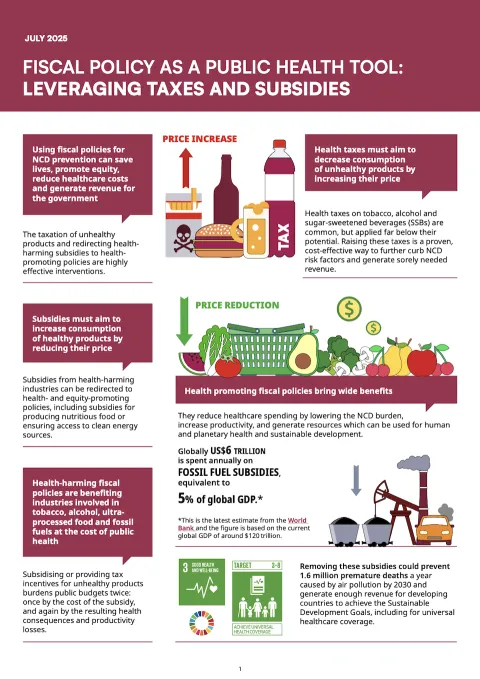
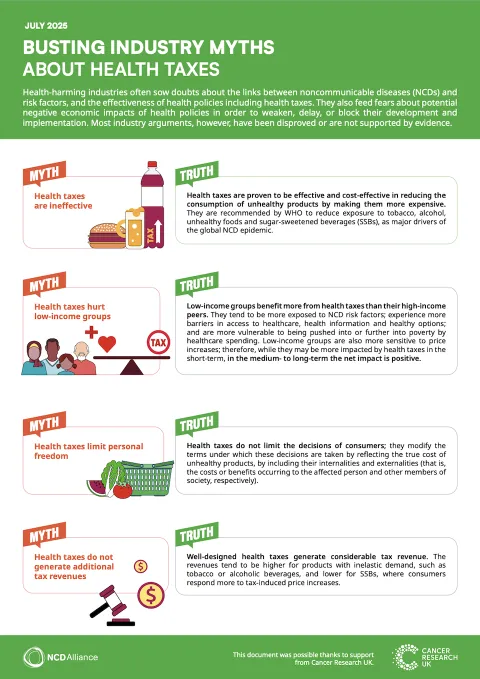
Dr Natalia Linos, Deputy Director for HIV and Health at UNDP, said governments already have tools available to finance action on NCDs, including health taxes and catalytic financing mechanisms.
“The health community has tools to finance NCDs. We have health taxes,” she said,
pointing to WHO’s 3 by 35 Initiative as a way to raise prices on tobacco, alcohol and sugary drinks through tax increases.
“That would be a saving for governments and would also give fiscal space.”
She also stressed the importance of aligning country support with country priorities, South-South learning, and making the cost of inaction visible.
Dr Ojo Tunde Massey Ferguson, National Coordinator of Nigeria’s National Mental Health Programme at the Federal Ministry of Health, highlighted the political will needed to accelerate progress on NCDs and mental health, including through prevention, care and healthier communities.
Mental health financing must not be left behind
James Sale, Deputy CEO of United for Global Mental Health, said mental health financing requires dedicated attention, not only because services remain underfunded, but because mental health is connected across the whole health system.
“Mental health should not be seen as a disease area with vertical interventions, but as a cross-cutting issue that can improve physical health outcomes across the health system.”
He also stressed the role of civil society in building political will and translating commitments into national policy and legislation.
Access to medicines remains a major barrier
Alison Cox, Director of Policy and Advocacy at NCD Alliance, said financing remains the “Achilles heel” of the NCD response, with access to medicines one of the most significant barriers to equitable care.
“Solutions to access barriers do exist — but we need political prioritisation and investment to match the scale of the NCD crisis,” she said.
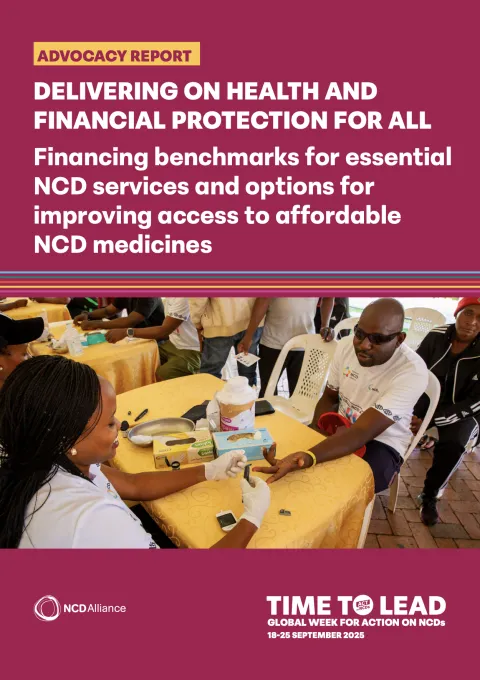
She highlighted findings from NCD Alliance’s report, Delivering on Health and Financial Protection for All, which shows that universal coverage of 13 WHO-recommended essential NCD primary health care interventions would require 1.1% to 1.7% of gross national income, while most countries currently spend only 0.26% to 0.46% on the same package.
Building momentum toward Manila
The side event came ahead of the third Global NCD and Mental Health Financing Dialogue, to be held in Manila in September 2026, and aimed to help align NCD and mental health financing strategies with universal health coverage and broader global health architecture discussions.
As WHA79 continues, NCD Alliance and partners are calling for governments to move from commitments to financed implementation, using the months ahead to identify practical pathways for domestic resource mobilisation, catalytic development assistance, access to medicines and sustainable investment.
Without adequate and sustained financing, the promise of the 2025 Political Declaration will remain out of reach for people living with NCDs and mental health conditions.