NCDA CEO Katie Dain opens webinar with a call for inclusive global health reform
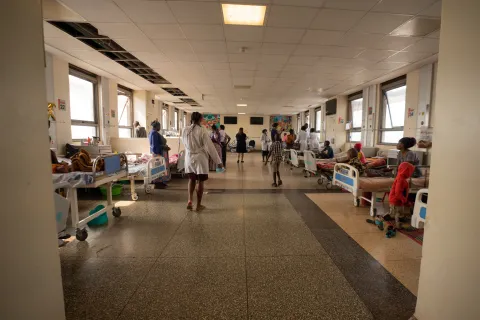
In her opening remarks at The Pulse of Tomorrow: Shifting the Paradigm for NCDs in Global Health Architecture webinar, co-organized by C-CAN and the Partnership for International Politics and Diplomacy for Health, NCD Alliance CEO Katie Dain underscored the critical role of civil society in shaping global health reforms, while warning that current WHO proposals risk sidelining the voices of people living with NCDs and undermining meaningful, community-grounded governance.
We’re meeting at a pivotal moment for global health. Drastic cuts to global health financing, combined with shifting geopolitics around multilateralism, are driving a “reimagining” of global health and reform to the global health architecture (GHA).
This provides an opportunity to shape an agenda for global health reform that responds to today and future global health challenges, and address the well-known flaws in the current system in terms of fragmentation, inefficiency, and donor-driven agendas to name a few.
One of the major global health challenges that has to be part of this conversation is noncommunicable diseases (NCDs) and mental health. The stats are well known: NCDs now cause 75% of all deaths globally, with 18 million of those deaths happening before age 70 — in people’s most productive years.
The numbers of people living with NCDs are staggering: 1.4 billion with hypertension, 500 million with diabetes, nearly 1 billion with mental health conditions, and 1 in 3 people with a neurological condition.
These numbers are rising fastest and disproportionately in the countries and communities least equipped to respond, with 73% of NCDs deaths occurring in low- and middle-income countries. In 4 years time, NCDs will overtake infectious disease and maternal health as leading cause of death in Sub-Saharan Africa. This is why NCDs are also a development and poverty issue. Overall, the world remains off track to meet Sustainable Development Goal 3.4 on reducing premature mortality from NCDs.
Conversely, one figure that has not changed is that less than 3% of development assistance for health has been allocated to these diseases over the past two decades.
This is the core problem: the historical exclusion of NCDs from global health policy and the global health architecture as it evolved has created a fundamental structural mismatch between global health funding and the actual NCD burden, now the greatest health challenge. The current GHA was built for a different era —the 1990s and early 2000s, during the Millennium Development Goals (MDG) period— when the focus was on infectious diseases and maternal and child health, and NCDs did not even feature as a footnote in the agenda. They were completely excluded.
The core design principle that emerged in global health, particularly during the MDG era and within the GHA, was a vertical approach. This led to the creation of major global health initiatives such as UNAIDS, the Global Fund, PEPFAR, GAVI, and more recently the Global Financing Facility, the Pandemic Fund, and CEPI. While these initiatives have driven significant advances, they have also contributed to imbalances in funding and uneven progress across the broader health landscape. This is evident in the WHO budget for 2024–2025, which totals $6.8 billion, with NCDs remaining among the most underfunded areas, receiving only $430 million.
This has had a direct knock-on effect on how health systems are designed at the national level, reinforcing vertical structures and a strong focus on acute care. As a result, many countries have developed highly effective services for specific health issues. However, care models for NCDs have lagged behind, particularly in low- and middle-income countries. This gap is particularly evident at the primary health care (PHC) level, despite its significant potential for prevention, early detection, and long-term management of NCDs.

“The role of civil society and impacted communities in both the reform process itself, as well as having a seat at the table in the governing bodies of what comes next, is absolutely critical.”
What are the implications of this new health reality, particularly regarding the NCD burden, for the GHA reform? Let me share a few recommendations, that are the focus of a new position paper we are launching at the World Health Assembly next week:
First, the reform process must go beyond addressing inefficiencies in the current system, and truly reorient to address the global health challenges of today and the future – which has to include greater prioritisation of NCDs and mental health. If we were designing the global health architecture from scratch today they would be central, not a bolt on we are struggling to accommodate.
Second, we are not proposing the creation of a new global health initiative dedicated to NCDs, and we never have. Rather, what is needed is a fundamental reset: a shift away from the vertical approaches of the MDG era towards a more integrated model aligned with the Sustainable Development Goals (SDGs)—a transition that remains overdue, even 11 years on. This means that global health initiatives and the GHA must move away from siloed, disease-specific programming and funding, and instead prioritise integrated, people-centred health system strengthening, with primary health care at its core.
There is already clear political consensus around this shift, reflected in commitments such as the UN High-Level Meetings on Universal Health Coverage, the Lusaka Agenda, UNAIDS’ 2023 “fourth 90” target, and the World Bank’s goal of reaching 1.5 billion people with integrated care. Several global health initiatives have begun to broaden their mandates in this direction at the strategic level—for example, the Global Fund and UNAIDS—which is a very welcome start. However, these efforts need to go much further. What is still required is a tangible shift in prioritisation and in the way systems are funded, in order to deliver health for all.
Third, if the new GHA is to meaningfully address NCDs, it must move beyond its current focus on diseases, treatment, and clinical care, and shift more decisively toward prevention. Premature deaths from NCDs—such as stroke, diabetes, and cardiovascular disease—are largely preventable, and the necessary interventions are well evidenced. However, these actions require upstream efforts that extend well beyond the health sector, including in areas such as environment, agriculture, education, trade, transport, and finance, to address key risk factors and social determinants.
To date, the GHA has been relatively weak in this regard and has fallen short of its potential. This is an opportunity to reboot and recalibrate, more deliberately leveraging the full breadth of the GHA and global public goods to promote healthier societies.
Fourth, there is a need to recentre power away from global hubs such as New York, Geneva, and Washington, D.C., and towards countries themselves—grounding decision-making in nationally defined priorities, country ownership, and health sovereignty. That is, a “one plan, one budget” approach to health systems, as the Lusaka Agenda put it.
This means placing countries in the driving seat, enabling them to set priorities based on their own disease burdens and health challenges, thus leading to a natural priotisation of NCDs and mental health.
Finally, the role of civil society and affected communities—both in the reform process itself and in having a seat at the table in the governing bodies of the resulting structure—is absolutely critical. Their involvement is essential to ensure that reforms are grounded in community realities.
There is, however, serious concern that the recent WHO proposal for a joint process on Global Health Architecture reform falls significantly short in this regard. The task force that has been proposed includes a whole range of different global health institutions and Member States. Not a single seat for civil society. I think that's something that we need to collectively look at and push for change fast.